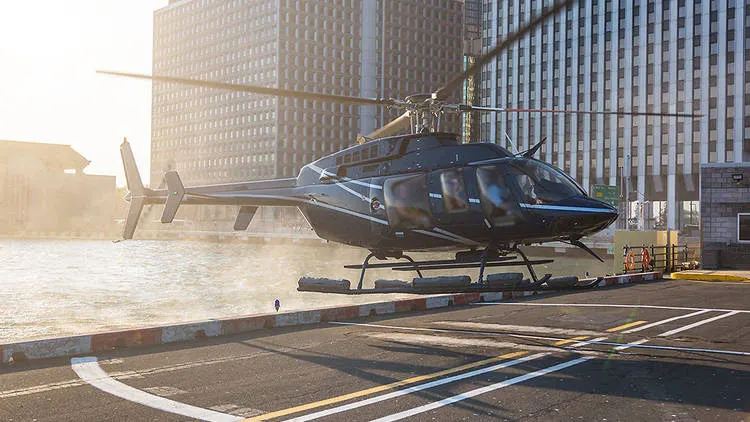
The sky of New York, between the skyscrapers of Manhattan and the Statue of Liberty in the distance, is an incessant ballet: helicopters filled with tourists amazed by the view of wealthy customers fly noisily over New York, to the despair of exasperated or disillusioned residents.
“With the bigger helicopters, my apartment vibrates,” complains Melissa Elstein, one of the leaders of Stop the Chop NY/NJ (New York/New Jersey), an association that wants to ban non-essential flights, such as tourist or wealthy client flights.
“It’s a business model that shouldn’t exist,” she says.
“They pollute the air, have a negative impact on health,” she adds, before attacking millionaires who “want to get to the airport a little faster, or for their weekends and vacations in the Hamptons,” the spit of land east of Long Island known for its beautiful beaches and grandiose villas.
This dispute has been going on for years and measures to regulate traffic have already been taken. But between 2020, when the pandemic reduced flights, and 2021, complaints about helicopter noise to City Hall’s 311 phone line increased from 10,359 to 25,821. The majority (21,620) came from the borough of Manhattan.
After a tune-up, the New York State Legislature passed a law earlier this month, called “Stop The Chop”, which opens the door to legal action for operators generating “excessive sustained noise”. But it still needs to be signed into law by the state’s governor, Democrat Kathy Hochul.
For Stop the Chop NY/NJ President Andy Rosenthal, it would be “the first step,” “but not what we hoped for.” “The fight continues,” he said.
“Many New Yorkers can no longer comfortably work from home, walk along the river, or take their children for a nap because of the incessant noise and vibration from non-essential helicopters,” argues Democratic Senator Brad Hoylman, author of the recent legislation, in a statement.
Helicopter noise is not only annoying, it is also “detrimental to our health and environment,” he added, saying that a helicopter produces 43 times more CO2 per hour than a conventional car.
New York City has three active heliports: one at 30th Street and the Hudson River – only separated from the roadway and its bike path by a metal fence – one at 34th Street and the East River, and one in the financial district of lower Manhattan.
At Battery Park, at the southwestern tip of Manhattan with the Statue of Liberty in the distance, the sky is constantly crossed by planes and helicopters.
Most residents have become accustomed to the abnormal decibel level of the area, which is already plagued by heavy traffic and ferries docking and departing from the nearby port.
For Mark Roberge, it is a “permanent background noise” that has become “part of the New York experience.”
“However, only essential flights should be allowed,” he says. “Tourist helicopters, which fly at low altitudes, are dangerous and should go much further.”
A 2016 agreement between New York City Hall and one of the operators reduced the number of tourist flights from 60,000 to 30,000 a year and confined them to the airspace of the rivers surrounding Manhattan, with the mandatory release on Sunday.
But with a minimum price of about $200 for a 15 to 20-minute flight, the experience is still attractive to tourists. The companies contacted did not respond.








Leave a Reply